Starting Out · Lesson 8
Behavior — feelings vs returns
Why the hardest part of long-run investing isn't the picks. It's holding.
7 min read
The hardest part of long-run investing isn't picking the right portfolio. It's holding the portfolio through the months when selling feels obviously correct. Lesson 4 covered the math side of this — drawdowns are temporary, recoveries show up. This lesson covers the part of the problem that lives in the head, not the spreadsheet.
The core idea: feelings about what a stock will do next aren't the same as what the stock will actually do next. Recent moves get treated as information; usually they aren't. What feels like a "clear opportunity" is usually a pattern, not an exception.
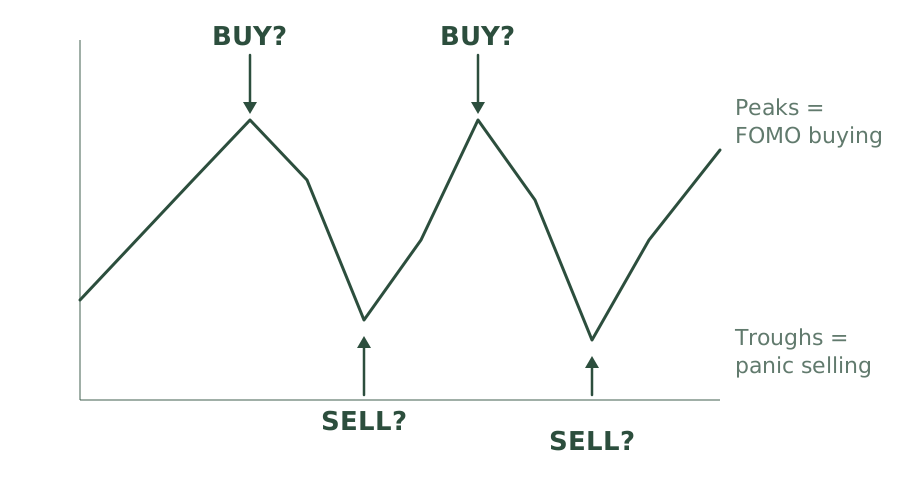
Four traps to recognize
These show up in patterns. Naming them in advance makes it easier to spot them in the moment.
Recency — treating the recent past as a guide to the future. A stock that doubled this year is no more likely to double again than any random stock. But the recent move sets the expectation. This is why people tend to buy after rallies and sell after drops.
Chasing past performance — moving money to last year's top funds, top sectors, or top countries. Long-term studies show that the average investor's returns lag the average fund's returns by about 1–2 percentage points per year, because of this pattern. The fund is up; the investor isn't, because they bought it after the run-up.
Herding — doing what visible others are doing. Social-media-driven flows into specific tickers are the current version. "Lots of other small investors are buying this" tells the buyer nothing about future return. The crowd has no special information.
FOMO (fear of missing out) — the urgency to act before some opportunity passes. The urgency is the trap. Long-run returns don't require timing the entry; they require staying in long enough.
Crypto, meme stocks, and the broader pattern
These aren't a different category from the four traps. They're the four traps at extreme amplitude. Crypto's 2020–2021 rally produced classic recency bias, performance-chasing into specific coins, social-media herding, and FOMO pump cycles all at once. The same pattern shows up in any environment where prices have risen sharply in a short stretch.
The lesson doesn't argue against owning a small allocation to anything — that's a separate decision. The point is that the certainty and urgency that surround these instruments are exactly the signal that the four traps are active. Slowing down and applying the base-rate framing (next section) usually shows that the "obvious" trade is the pattern, not the exception.
The base-rate question
The defense against the four traps isn't being smart — it's being slow enough to ask one question: what's the long-run base rate?
- For "last year's hot stock keeps being hot" — the base rate is below 50%.
- For "the long-run stock-market average shows up for the patient holder" — the base rate is much higher.
Reaching for the base rate isn't conservative or skeptical. It's the only honest reference point. Recent moves are loud and feel like information; base rates are quiet and actually are.
Feelings about future returns aren't returns.
Two reactions to the same headline
A tech stock has tripled over the last 12 months. A coworker mentions it.
Riley thinks "I should buy some before it keeps going up." Riley buys $5,000 of the stock with cash that was earmarked for the diversified portfolio. Over the next year, the stock falls 40% as the rally fades. Riley sells at the bottom and locks in the loss.
Casey notes that the recent triple is in the past and is already in the price. The base-rate question — "does last year's hot stock keep being hot?" — has a known answer (no, usually). Casey continues the monthly contribution to the broad-market portfolio. That portfolio already owns a slice of the same stock, weighted by its share in the broad market. Whatever the stock does next, Casey's exposure is proportional.
Same headline, two responses. The headline's job was to create urgency. Casey's job was to recognize the pattern.
Further reading
- Thinking, Fast and Slow — Daniel Kahneman. The canonical reference on how the mind makes mistakes. Chapters on availability and anchoring directly explain the recency bias this lesson covers.
- Morningstar 'Mind the Gap' annual reports — Morningstar Research. The yearly report that quantifies the gap between average fund returns and average investor returns. The source for the '1–2 points per year' figure cited in this lesson.