Starting Out · Lesson 9
Accounts — where to hold the investments
The same portfolio inside the right account keeps tens of thousands more over 30 years.
7 min read
A is just an account type — a Roth IRA, a Traditional IRA, or a 401(k) in the US. The investments inside don't change. The same broad-market ETF held in any of them earns the same returns. What changes is how the government taxes those returns.
The wrapper doesn't make any money. But over 30 years, the right wrapper keeps tens of thousands more than the wrong one. Same portfolio, same contributions, same returns. Different tax treatment.
The three US wrappers
Roth IRA. Money goes in after tax (a regular paycheck, no tax break). The investments inside grow tax-free. Qualified withdrawals in retirement are tax-free. Contribution limit in 2025: $7,000 a year ($8,000 if 50 or older). Income limits phase out contributions for higher earners — about $165,000 single or $246,000 married in 2025.
Traditional IRA. Money goes in before tax. The contribution lowers the year's taxable income, which usually means a refund at tax time. The investments inside grow tax-deferred. Withdrawals are taxed as regular income, usually decades later in retirement. Same $7,000 contribution limit. Required withdrawals begin at age 73.
401(k). Employer-sponsored. Contribution limit is much higher: $23,500 a year in 2025 ($31,000 if 50 or older). Many employers offer a match — commonly 3 to 6 percent of salary. A 401(k) can be Traditional (pre-tax) or Roth (after-tax); the tax treatment matches the IRA versions.
(There's also the HSA — a high-deductible health-plan account that's tax-free on the way in, on growth, and on qualified medical withdrawals. Worth its own lesson; not covered here.)
A worked example
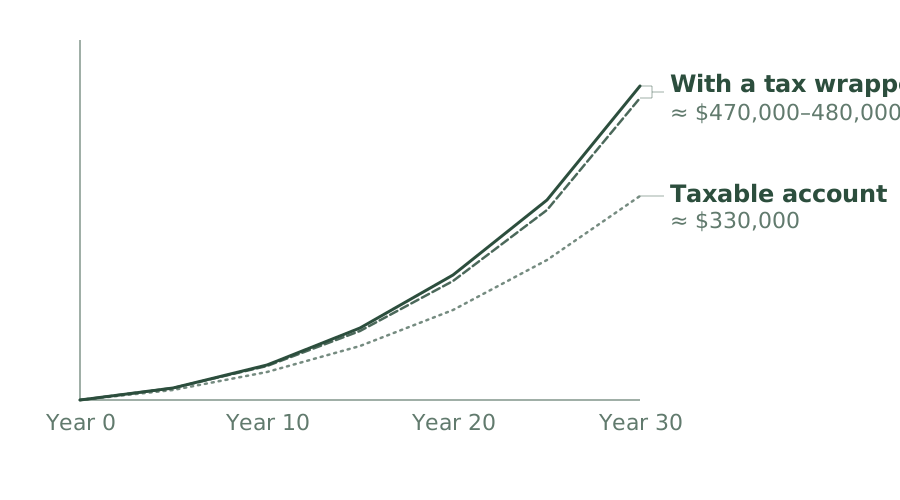
Drew contributes $5,000 a year for 30 years. The investments earn about 7% a year. Same investments, same amounts. The only thing that changes is the wrapper.
Roth IRA path. $5,000 of after-tax money goes in each year. After 30 years, Drew's balance is about $472,000. Qualified withdrawals are tax-free.
Traditional IRA path. The same $5,000 contributes, and the contribution returns about $1,100 in tax refund at a 22% rate. If Drew reinvests the refund alongside, the after-tax wealth at year 30 is roughly $480,000 — close to the Roth, slightly ahead when the retirement tax bracket is lower than today's.
Taxable account. $5,000 of after-tax money, but the gains get taxed every year as they happen. The yearly drag is about 0.7 to 1.5%. After 30 years, the balance is closer to $360,000.
Same contributions, same investments. The wrapper choice was worth more than $100,000.
Rules of thumb
These are starting heuristics, not rules. A tax pro can adjust them for the specific case.
- Employer 401(k) match. Take the full match first, before any other wrapper choice. A 50% match is a guaranteed 50% return on the matched portion — better than any other option in this lesson.
- Current tax bracket lower than expected retirement bracket. Roth tends to win. Pay tax now at the low rate, grow tax-free, withdraw tax-free.
- Current tax bracket higher than expected retirement bracket. Traditional tends to win. Take the refund now at the high rate, pay tax later at the lower rate.
- Income above the Roth IRA limit. The "backdoor Roth" (a non-deductible Traditional contribution converted to Roth) is the standard workaround. It has its own rules; check with a tax pro.
- Same tax bracket now and later. Roth and Traditional are mathematically equivalent. Many pick Roth for the flexibility (no required withdrawals, no future tax-rate risk).
The wrapper doesn't grow the money. It decides how much of it the holder keeps.
Two careers, two right answers
Quinn earns $48,000 a year (a low tax bracket today). A successful career means probably earning more later. The Roth IRA fits — pay the small tax now at the low bracket, lock in tax-free growth, skip the future tax bracket entirely.
Taylor earns $180,000 a year (a high tax bracket today). Retirement income will probably be lower than this. The Traditional refund is worth more today at the high rate than the future tax on withdrawal will cost. Take the refund now.
Both contribute the same amount. The right wrapper is different because the tax-rate signal is different.
Further reading
- The Bogleheads' Guide to Retirement Planning — Taylor Larimore, Mel Lindauer, Richard Ferri, Laura Dogu. Plain-language US guide that walks through the Roth IRA, Traditional IRA, and 401(k) basics with worked examples. The wrapper chapters are the most direct match for this lesson.
- IRS — Retirement Plans and IRA pages — Internal Revenue Service. The official rules on contribution limits, income phase-outs, and withdrawal treatment for the current tax year. The numbers change every year — worth bookmarking.