Starting Out · Lesson 6
ETFs and index funds
The vehicle that owns the whole basket in one share.
7 min read
Owning all 3,000+ companies in the broad market sounds like it would take an army of trades. It doesn't. A single financial product wraps thousands of stocks into one share — and the yearly cost is less than the price of a coffee.
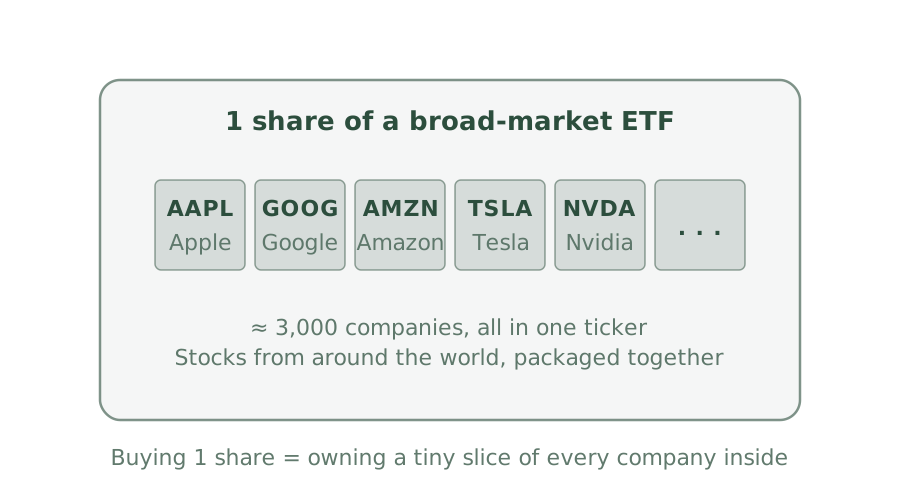
That product is an ETF — an exchange-traded fund. One ticker, one purchase, and the buyer owns a tiny slice of every company inside the fund.
How an ETF actually works
An ETF holds a basket of investments — stocks, bonds, or both. The fund itself trades on a stock exchange, like a single stock. Buying one share gives the buyer a tiny piece of everything the fund holds.
A broad-market stock ETF tracks an — a published list of companies put together by a research firm. The list says which stocks the ETF holds and how much of each. Three common ones: the S&P 500 (the 500 largest US companies), the CRSP US Total Market Index (most of the US market), and the FTSE Global All Cap (most of the world's listed companies). When a company in the index grows, the ETF holds more of it. When a company shrinks, the ETF holds less. No human picks the stocks — the index decides.
Three US options
Three US-listed ETFs cover the realistic broad-market choices for a starting investor:
- VTI (Vanguard Total Stock Market ETF): tracks the CRSP US Total Market Index — about 3,700 US stocks across large, mid, and small companies. Yearly fee: about 0.03%.
- VT (Vanguard Total World Stock ETF): global stock exposure, about 9,800 stocks. Roughly 63% US, 37% international developed and emerging. Yearly fee: about 0.07%.
- VOO (Vanguard S&P 500): tracks the S&P 500 — about 500 large US companies. Yearly fee: about 0.03%.
VTI is the total US market; VT is the total global market; VOO is large US companies only. All three are common starter choices. A starter portfolio using VT in a single purchase covers the broad-market idea from the last lesson globally; VTI does the same for US-only exposure. The trade-off is geographic breadth, not quality.
Why the manager-picked alternative usually isn't the answer
A common alternative is an actively managed fund — one where a paid manager picks the stocks. These funds cost more. Yearly fees of 0.5–1.5% are typical, some higher. They also tend to lose to the broad market over the long run. Long-term studies show that about 80% of actively managed US large-cap stock funds lose to their benchmark over 15-year stretches.
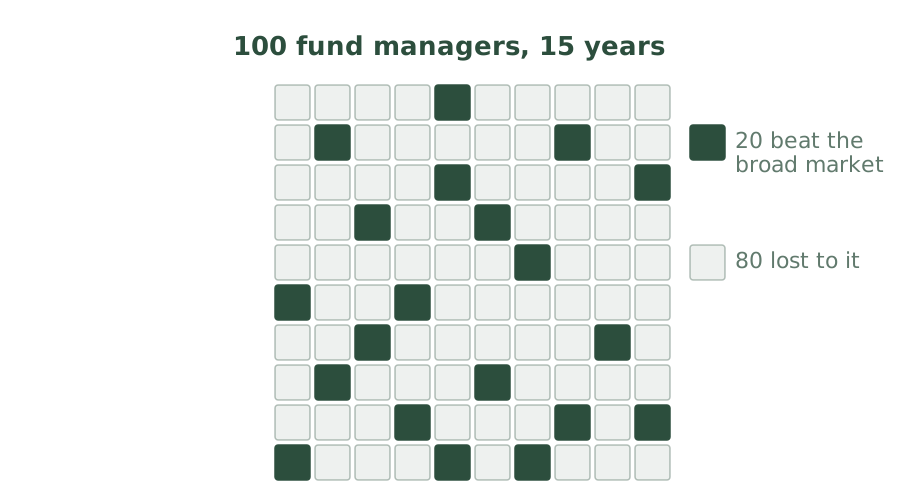
The 20% that beat it aren't easy to spot in advance. Past wins don't reliably predict future wins. So the fee is guaranteed; the extra return isn't.
Over 30 years, a 1% yearly fee gap adds up to roughly a 20–25% gap in the final balance. The next lesson covers how that math works.
A sector ETF isn't broad diversification
Sector ETFs (technology-only, banks-only, energy-only) are bets on one slice of the market. They look diversified at the company level, but they're concentrated at the sector level. The small group of long-term winners from the last lesson depends on owning the whole market — not one slice.
Sector ETFs have their uses, but they aren't a substitute for the broad-market core. The same caution applies to theme ETFs (clean energy, AI) and single-country ETFs. They concentrate by design.
The simplest path is one broad-market ETF in one purchase. The diversification is automatic.
Two starter portfolios, same $5,000
Drew opens a brokerage account and buys $5,000 of VT — one purchase, about 9,800 stocks owned globally. Drew sets up automatic monthly contributions to add to the position over time. The portfolio is globally diversified from day one. The yearly cost is about $3.50 per $5,000.
Jamie spends a few weeks researching individual companies. Jamie buys $5,000 split across 8 US stocks Jamie has read good things about. The portfolio is concentrated in 8 names. If one of the small group of long-term winners from the broad market isn't in those 8, Jamie misses it.
The difference isn't in the effort spent. Drew did less work and got broader coverage. Jamie did more work and ended up more exposed to single-stock risk.
Further reading
- Common Sense on Mutual Funds — John Bogle. The case for index investing, from the founder of Vanguard. Documents why low-cost broad-market funds beat most actively managed alternatives over the long run.
- S&P SPIVA scorecards — S&P Dow Jones Indices. The twice-yearly report that tracks active-vs-index fund performance across regions. The source for the '80% underperform' figure cited in this lesson.